
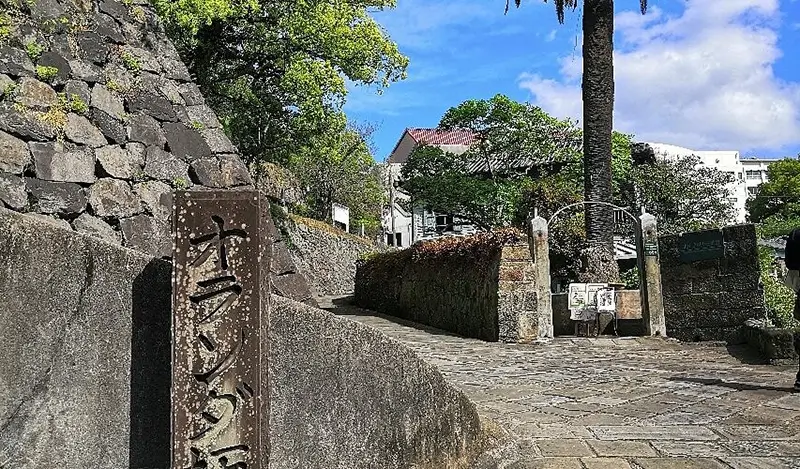
What is Dutch Slope (Orandazaka) in Nagasaki?
Dutch Slope, or Orandazaka (オランダ坂), is a quiet stone path in Nagasaki’s Higashi-Yamate area. It got its name because many Westerners lived nearby in the 1800s—not just Dutch people, but also British and American traders.
Today, you can still walk past old Western-style houses, ivy-covered walls, and scenic corners. It’s one of the best places in Nagasaki to enjoy a peaceful walk and take great photos.

I walked past a quiet row of preserved Western-style houses. One had delicate lace curtains in the window and a small brass plate near the door—details that hinted at the lives once lived here.
History of the Dutch Slope

During the late Edo period and into the early Meiji era, Nagasaki was one of the few Japanese cities open to foreign contact. It quickly became a center for trade and Western influence. As Japan modernized after 1868, more Westerners arrived—traders, missionaries, and diplomats. Many settled in the Higashi-Yamate area, where Dutch Slope is located.
The name “Orandazaka” (オランダ坂), or “Dutch Slope,” doesn’t only refer to people from the Netherlands. In 19th-century Japan, “Dutch” was a common term for all Westerners. This came from the Edo period, when the Dutch were the only Europeans officially allowed to trade with Japan.
Along the slope, many Western-style homes were built using brick and timber—rare materials in Japan at the time. These houses had balconies, steep roofs, and glass windows, showing a clear Western influence. Some of these buildings still remain today. One example is Higashi Yamate 13-ban Kan (東山手十三番館), a public heritage site where visitors can step inside a preserved Western-style house from that era.

Inside the Higashi Yamate 13-ban Kan, I saw old furniture, high ceilings, and glass-paneled doors. It felt like stepping into a 19th-century Western residence. It’s amazing that these homes—once lived in by foreign residents—are still standing here in Nagasaki.
Around Dutch Slope – Nearby Sights to Explore
Glover Garden
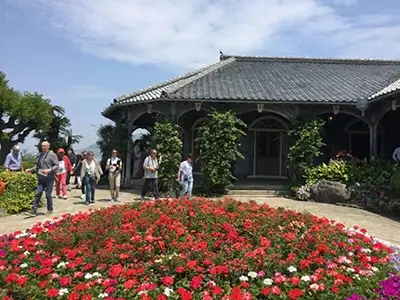
A scenic open-air museum of preserved Western homes from the Meiji era. Enjoy panoramic views over Nagasaki Port and learn about the life of Scottish merchant Thomas Glover, who played a key role in Japan’s modernization.
Visit early in the morning to avoid crowds and catch great photo lighting.
Oura Church

Japan’s oldest existing Christian church, built in 1864 by French missionaries. This Gothic-style building is now a UNESCO World Heritage Site and offers a quiet look into Nagasaki’s Christian history.
It’s located just downhill from Glover Garden—an easy add-on to your walk
Dejima
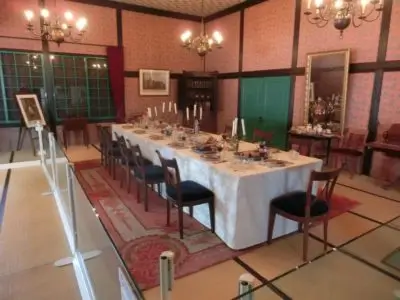
A restored former trading post that once served as Japan’s only official window to the West during the Edo period. You can explore reconstructed buildings, exhibits, and the unique layout of the fan-shaped island.
A great spot for history lovers—especially if you’re interested in Japan’s isolation era.
I spent a full morning walking from Dutch Slope to Glover Garden, Oura Church, and finally Dejima. Each spot revealed a different part of Nagasaki’s international past—from 19th-century merchants to early missionaries and Edo-period trade.
How to Get to Dutch Slope
Location
Dutch Slope (Orandazaka) is located in the Higashi-Yamate district of Nagasaki, a historic hillside neighborhood with Western-style architecture. It’s within walking distance of Glover Garden, Oura Church, and Dejima, making it ideal for a combined visit.
How to Get There
From Nagasaki Station, take the streetcar (Tram Line 5) bound for Hotarujaya
→Get off at Shinchi Chinatown Station or Shiminbyoin-mae Station (市民病院前)
→Walk 8–10 minutes uphill toward Higashi-Yamate
Q&A – Dutch Slope & Nagasaki Area
What is the Dutch area of Nagasaki?
The “Dutch area” refers to the historic hillside district in Nagasaki where Western residents—especially the Dutch—lived in the late 19th century. It includes landmarks such as Orandazaka (Dutch Slope), Glover Garden, and Dejima, all reflecting Nagasaki’s role as Japan’s gateway to the West.
What was the Dutch island in Nagasaki?
Dejima was a fan-shaped artificial island built in 1636 to house Dutch traders. During Japan’s era of isolation, it was the only point of contact with the Western world.
Is Dejima worth visiting?
Yes—especially for history lovers.
Restored buildings, exhibitions, and reconstructed trade offices give a clear picture of life during Japan’s sakoku (closed country) era.
What is the best thing to buy in Nagasaki?
Popular souvenirs include Castella sponge cake, biwa (loquat) jelly, and Western-inspired goods from shops near Dutch Slope.
How much time should I spend around Dutch Slope?
Allow at least 30–45 minutes to enjoy Dutch Slope itself.
If you also plan to visit nearby sites like Glover Garden, Oura Church, and Dejima, a half-day (2–3 hours) is ideal for a relaxed walk with photo stops.
Visitor Info – Dutch Slope, Nagasaki
- Location: Higashi-Yamate District, Nagasaki City
- Entry Fee: Free
- Opening Hours: Open 24 hours (outdoor public area)
- Photography: Allowed. Early morning or late afternoon offers the best natural light.
- Nearby Rest Areas: Benches available along the slope; cafés and shops within 5 minutes’ walk
- Barrier-Free Access: The slope is steep and cobbled—comfortable shoes are recommended. Wheelchair access is limited.

The morning hours are best for quiet photos—and the light hits the slope beautifully from the east.
Last updated: December 2025