
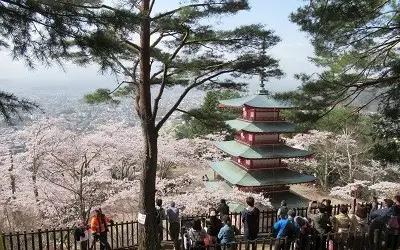
You’ve probably seen it: a vivid red pagoda, soft pink cherry blossoms, and Mt. Fuji standing quietly in the background.This is Chureito Pagoda, one of Japan’s most iconic photo spots—and yes, it’s real.
Located within Arakurayama Sengen Park in Yamanashi Prefecture, the pagoda sits atop a hill with a sweeping view of Mt. Fuji and the surrounding city of Fujiyoshida. If you’re planning a trip to Japan and wondering whether it’s worth the climb—the answer is yes.
→Want to take in these views—and more—without the hassle? A guided tour is a great way to enjoy the whole area.
Climbing to the Viewpoint
The closest station is Shimoyoshida Station on the Fujikyu Line. From there, it’s a 10-minute walk to Arakura Fuji Sengen Shrine, where your climb begins.
At the shrine’s entrance, you’ll pass through a towering torii gate—a symbolic entrance to sacred ground.
Before even reaching the pagoda, many visitors stop to photograph this gate with Mt. Fuji framed in the distance.
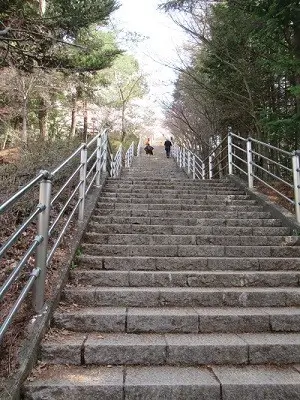
To reach the famous viewpoint, you’ll climb 398 stone steps through a pathway lined with cherry trees. The number 398 (pronounced “sa-ku-ya”) is a reference to Konohana Sakuya-hime, the Shinto goddess of Mt. Fuji.
In early April, the stairs become a tunnel of blossoms.

I visited in early April 2025! It took me less than two hours from central Tokyo to get there.When I arrived at Shimoyoshida Station, the skies were clear and the cherry blossoms were in full bloom.
The walk up the 398 steps was absolutely gorgeous—pink petals everywhere, and Mt. Fuji was visible between the branches.
At the Chureito Pagoda
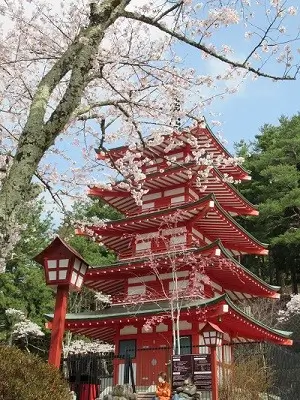
At the summit stands the vivid red Chureito Pagoda, built in 1963 as a peace memorial.
Behind it is the famous viewing platform, where visitors line up to capture Mt. Fuji, the pagoda, and seasonal color—all in one iconic frame.
But getting the perfect shot isn’t always easy.
Even during cherry blossom season, clouds and haze often hide Mt. Fuji, especially in the afternoon.Early morning gives you the best chance.
Still, even without Fuji, the view of the pagoda surrounded by blossoms or autumn leaves is breathtaking—and absolutely worth the climb.

By the time I reached the platform, clouds had started to roll in and Fuji was mostly hidden.
But the view of the pagoda with cherry blossoms all around was still magical.Just when I was about to leave, the summit peeked through the clouds for a few seconds.
Everyone cheered—it was like the mountain gave us a reward for waiting.
A Brief History
While Chureito Pagoda was built relatively recently in 1963 as a peace memorial, the site itself has a much deeper history.
Arakurayama Sengen Park officially opened to the public in 1959, but the Arakura Fuji Sengen Shrine, located at the base of the steps, dates all the way back to the year 705.
Originally established to enshrine the spirits of the local Arakura family, the shrine played an important role during Mt. Fuji’s ancient eruptions.
When Mt. Fuji erupted in 807, a special ritual was held here to calm the mountain’s spirit.
As part of this ritual, the Emperor Heizei granted the shrine the title “Sangoku Daiichi”—meaning “the top shrine of the region”—along with an imperial plaque.
There are many Sengen shrines across Japan, all dedicated to Konohana Sakuya-hime, the goddess of Mt. Fuji.
They share a common purpose: to prevent Mt. Fuji from erupting. For centuries, people have believed that eruptions occur when the mountain deity is angered—so they pray to soothe her spirit.

This isn’t just a photo spot—Chureito means “Pagoda of Loyal Souls.”
It was built to honor those who gave their lives, and I always try to pause for a moment of quiet before I take any pictures.
❓ Q&A – Arakurayama Sengen Park & Chureito Pagoda
What is the Chureito Pagoda?
It’s a five-story red pagoda built in 1963 as a peace memorial. What makes it special is its view—Mt. Fuji behind the pagoda, framed by cherry blossoms or autumn leaves. That’s the photo everyone’s chasing!
Is Chureito Pagoda worth it?
Definitely. It’s one of the most iconic views in Japan, and it’s free to visit! Even if Mt. Fuji is hidden, the atmosphere at the top is beautiful year-round.
How many steps are there?
Approximately 398 steps, chosen to reflect the name “Sakuya,” the goddess of Mt. Fuji. A beautiful bit of symbolism!
How do I get to Chureito Pagoda from Tokyo?
Take the JR Chuo Line from Shinjuku to Otsuki, then the Fujikyu Line to Shimoyoshida Station.
From there, it’s a 10-minute walk to the base of the stairs.
When is the best time to go?
Early morning on a clear day. Spring and autumn are most popular, but winter offers the clearest views and the fewest crowds.
Visitor Info (as of 2026)
• Location : Arakurayama Sengen Park, Fujiyoshida, Yamanashi
• Nearest Station : Shimoyoshida Station (Fujikyu Line), ~10 min walk
• Viewpoint Access : On foot only
• Hours : Open 24 hours (no gates), best during daylight
• Admission : Free
• Facilities : Restrooms at the base; vending machines; no shops at the top